
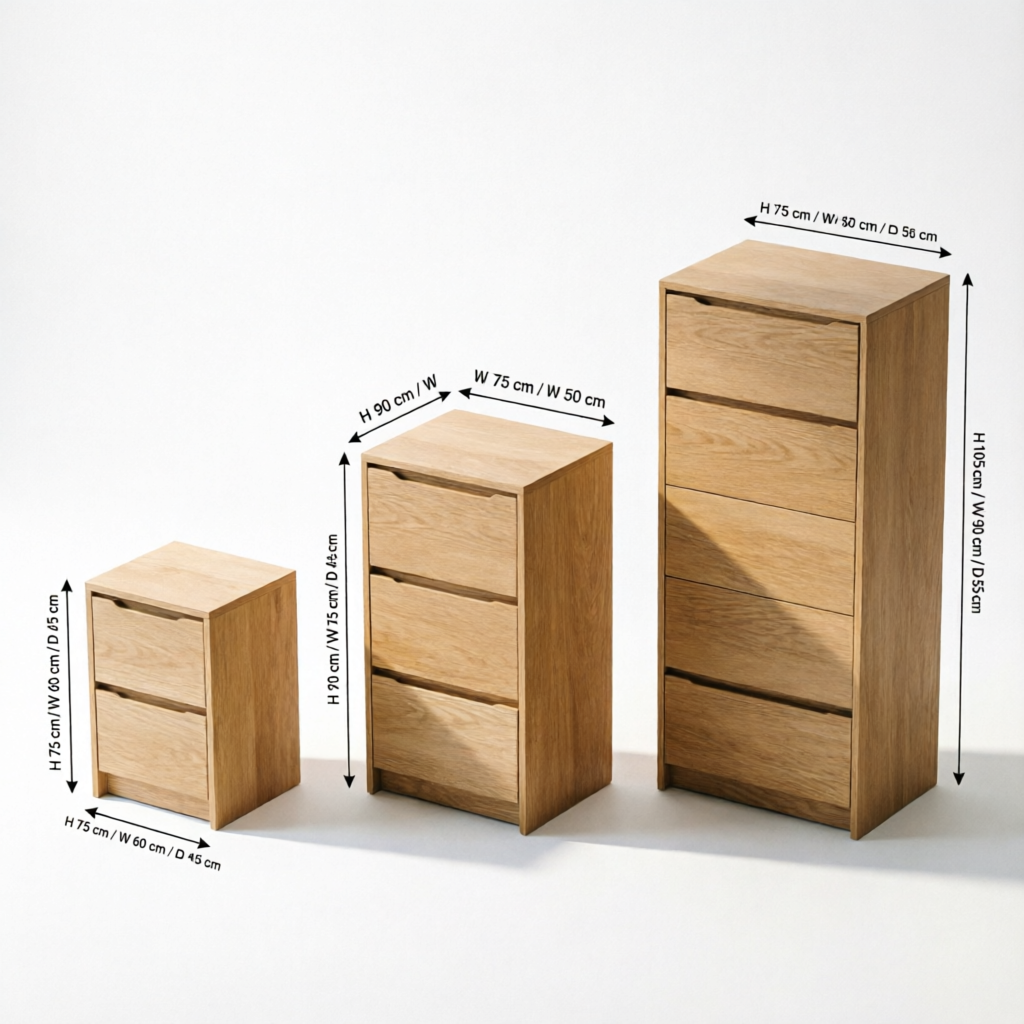
Buying a dresser online feels like a gamble sometimes. You find one that looks great in the photos, hit order, and then it arrives — way bigger or smaller than you expected. It’s a common problem, and it almost always comes down to dimensions.
This guide breaks down standard dresser sizes so you know exactly what to look for. Whether you’re furnishing a small guest room or a master suite, you’ll leave here knowing the right width, height, and depth for your space.
Why Dresser Dimensions Matter
A dresser that’s the wrong size doesn’t just look off — it makes the whole room harder to use. Too wide, and you’re squeezing past it every morning. Too tall, and it blocks your window or feels overwhelming in a small space. Too shallow, and your clothes don’t fit properly.
Here’s what happens most often:
- Overcrowding: A 60-inch dresser in a room with a queen bed leaves barely any walking space
- Drawer clearance failure: You didn’t account for the drawers opening, so now they hit the bed frame
- Delivery nightmare: The dresser fits the room but not the hallway getting there
Getting the dimensions right before you buy saves returns, restocking fees, and a lot of frustration. You can check our best dressers roundup for size-specific recommendations after you know what you need.
Standard Dresser Dimensions by Type
Dressers fall into four main size categories. Each one serves a different room setup and storage need.
Small Dressers (3 Drawer) — 24-30” Wide
Small dressers are the most versatile size category. They fit places larger dressers can’t — narrow wall sections, small bedrooms, entryways, and even closets.
- Standard width: 24 to 30 inches
- Standard height: 26 to 30 inches (matches most bed frame heights)
- Standard depth: 12 to 16 inches
The AODK 3-Drawer Dresser is a great example of this category. At 23.6 inches wide, 27.6 inches tall, and just 11.8 inches deep, it works as a bedside table replacement, a guest room dresser, or an entryway storage piece. The shallow depth means it fits even narrow hallways without blocking traffic.
These dressers are ideal for:
- Kids’ rooms where floor space needs to stay open for play
- Guest rooms that only need storage for a few items
- Nightstand replacements — the height matches standard bed frames
- Entryways and mudrooms for daily essentials
Don’t expect to store everything here. A 3-drawer dresser holds about one person’s worth of folded basics — t-shirts, underwear, socks. For full wardrobe storage, you’ll need a larger option.
For more options in this size, check our best dressers for small spaces guide.
Standard Dressers (5-6 Drawer) — 30-50” Wide
This is the most common dresser size for a reason. A standard dresser handles a full wardrobe for one person comfortably and fits most master bedrooms without dominating the room.
- Standard width: 30 to 50 inches
- Standard height: 30 to 36 inches
- Standard depth: 15 to 20 inches
The Orgobysol 6-Drawer Double Dresser measures 47.2 inches wide, 32.3 inches tall, and 15.3 inches deep — right in the sweet spot for this category. The six drawers give you dedicated space for shirts, pants, sweaters, and undergarments without mixing everything together.
The difference between 5-drawer and 6-drawer models is mostly about drawer height. Five-drawer dressers usually have taller individual drawers for bulkier items like jeans and sweaters. Six-drawer dressers split the space into more compartments with shorter drawers, which helps with organization.
Standard dressers work well in:
- Primary bedrooms for one person
- Shared bedrooms — each person can have their own standard dresser
- Rooms where you want a dresser that doubles as a TV stand surface
The top surface of a standard dresser (30-50 inches wide) provides enough room for a TV up to 55 inches, decorative items, or daily essentials like a jewelry tray.
Some of the best dressers for bedrooms fall into this size range because it balances storage and footprint so well.
Tall Dressers & Chests — 20-30” Wide, 35-50” Tall
Tall dressers solve a specific problem: you need storage but don’t have much floor space. By going vertical, these pieces pack 5 to 8 drawers into a narrow footprint.
- Standard width: 20 to 30 inches
- Standard height: 36 to 50 inches
- Standard depth: 14 to 18 inches
The 5 Drawer Dresser for Bedroom, White Dresser Chest of Drawers is a classic tall chest at 23.7 inches wide, 40.4 inches tall, and 15 inches deep. It takes up less than 2 feet of wall space but still gives you five full-depth drawers.
The WLIVE 12-Drawer Tall Dresser pushes the vertical concept further — 23.6 inches wide but 47.2 inches tall with 12 drawers. The fabric drawers keep weight down (important for tall furniture), and the top surface provides space for decor or a small lamp.
Here’s the key difference between chests and tall dressers:
- Chests usually have deeper, wider drawers and a more traditional look
- Tall dressers may use shallower fabric bins or metal-frame drawers
- Both save floor space, but chests tend to hold bulkier items better
A quick note on safety: tall dressers are more prone to tipping. Always use the included anti-tip hardware to anchor them to the wall. This is non-negotiable, especially in kids’ rooms.
Tall dressers are best for:
- Small bedrooms under 100 square feet
- Apartments where floor space is at a premium
- Walk-in closets as interior storage
- Dorm rooms and studio apartments
Our best tall dressers guide has more vertical options if this category fits your room.
Extra-Wide Dressers (Double/Lingerie) — 50-80” Wide
Extra-wide dressers are the heavy lifters of bedroom storage. With 8 to 12 drawers spanning 50+ inches, these can handle a full wardrobe for two people.
- Standard width: 50 to 80 inches
- Standard height: 28 to 34 inches
- Standard depth: 15 to 20 inches
The WLIVE 12-Drawer at 47.2 inches tall is actually narrower than most extra-wides at just 23.6 inches wide, so it’s more of a tall dresser. True extra-wide models start around 50 inches and go up. These dressers are the ones that double as serious TV stands — a 60-inch dresser can support a TV up to 65 inches.
What makes extra-wide dressers different:
- Drawer configurations vary: 6 wide drawers, 9 drawers (3 rows of 3), or 12 drawers (4 rows of 3)
- The wider footprint means you can organize by category much more easily
- Some models include a mix of shallow and deep drawers
- They work best in rooms where you have at least 8 feet of available wall space
Extra-wide dressers are ideal for:
- Master bedrooms with long empty walls
- Couples sharing one dresser — assign each person 4-6 drawers
- Large families where one person’s clothing fills a standard dresser
- Rooms where the dresser doubles as a media console
How to Measure Your Space for a Dresser
Before you look at any product listings, measure your space. This takes five minutes and saves hours of frustration.
Step 1 — Measure Width
Width is the most common mistake. People measure the wall space and pick a dresser that fits — but forget about everything around it.
Here’s how to measure properly:
- Measure your available wall space from corner to nearest obstruction (window, door frame, outlet)
- Subtract 24 to 36 inches on each side for drawer clearance — this is the space needed for drawers and walking
- Account for baseboards — they add 0.5 to 1 inch on each side, and your dresser needs to sit flat against the wall
- Check door swing — if a door opens into the dresser area, you need clearance for the door’s full arc
For example, if you have a 10-foot wall (120 inches) with a door on one side, you lose about 36 inches for the door swing. Your usable space is roughly 84 inches, so a 60-inch dresser leaves 12 inches on each side — minimum but workable.
Step 2 — Measure Height
Height matters for three reasons: your eye level, wall decor above the dresser, and any mirrors or TVs you plan to place on top.
- The dresser top should be at or below eye level when you’re sitting in bed (roughly 36 to 42 inches for most people)
- If you’re placing a mirror on top, add the mirror height and make sure the total stays below 60 inches (standard picture rail height)
- Wall art above the dresser should have its center at 57 to 60 inches from the floor — subtract half the art height plus the dresser height to get the right placement
- For TV placement, the center of the screen should be at seated eye level — a 32-inch tall dresser with a 50-inch TV (mounted) puts the screen center right around 42 inches, which is ideal
Tall dressers (44-50 inches) work well in rooms without wall art above them, or when placed in corners where the height feels proportional.
Step 3 — Measure Depth
Depth is the dimension people forget most often, and it causes the most problems after delivery.
A dresser’s depth is not the same as its footprint depth. You also need:
- Drawer extension: Most drawers extend 80-90% of their depth. A 16-inch deep drawer needs about 14 inches of pull-out space
- Walking clearance: Minimum 30 inches from the dresser front to the nearest obstruction (bed, wall, opposite furniture)
- Total depth needed: Dresser depth + open drawer depth + walking clearance
So a 16-inch deep dresser with fully open drawers needs about 30 inches (16 + 14), plus 30 inches of walking space = 60 inches of total depth from the wall. Measure from the wall where the dresser sits to the nearest obstacle to see if you have enough room.
If you’re looking at multiple dressers, our how to choose a dresser guide walks through all these measurements in more detail.
Dresser Dimensions by Room Size
Different rooms need different approaches. Here’s how to match dresser size to your actual room dimensions.
Small Bedroom (under 100 sq ft)
In a room under 100 square feet (roughly 10x10 or smaller), every inch matters. Your bed takes up most of the floor space, and you have limited wall area for storage.
- Max dresser width: 30 inches
- Best type: Tall chest or 3-drawer dresser
- Alternative: Skip the standalone dresser and use closet organizers instead
The AODK 3-Drawer Dresser at 23.6 inches wide is a perfect small-bedroom fit. Place it next to the bed as a nightstand replacement to save floor space, or put it against the longest available wall.
The WLIVE 12-Drawer at 23.6 inches wide gives you more vertical storage in the same footprint — four times the drawers without taking up more floor space.
Key rules for small bedrooms:
- Go vertical — tall chests and vertical dressers store more in less floor space
- Measure the path — a 48-inch tall dresser needs to get through the door first
- Skip double dressers — anything over 30 inches wide will make the room feel cramped
- Consider fabric drawers — lighter weight means easier rearranging if you need to change the layout
- Leave walking space — you need at least 24 inches between furniture pieces
Medium Bedroom (100-150 sq ft)
Most master bedrooms in apartments and smaller homes fall into this range. A 12x12 room (144 sq ft) gives you enough space for a queen or king bed plus one larger dresser.
- Max dresser width: 50 inches
- Best type: Standard 6-drawer dresser or tall dresser + nightstand combo
- Layout options: Dresser on longest wall, bed centered on opposite wall
The Orgobysol 6-Drawer Double Dresser at 47.2 inches wide is an ideal fit for a medium bedroom. It gives you full wardrobe storage for one person without overwhelming the room. Pair it with a small nightstand on the other side of the bed for a balanced layout.
You also have the option to use a tall chest (like the 5 Drawer Dresser at 23.7 inches wide) plus a separate nightstand. This split approach can look more intentional and gives you more surface area across the room.
Layout options for medium bedrooms:
- Single standard dresser + bed + 1 nightstand: Clean, minimal, leaves the most floor space
- Tall chest + bed + 2 nightstands: More storage with a symmetrical look
- Standard dresser + bed + chest combo: Maximum storage, but room starts feeling full
Large Bedroom (150+ sq ft)
Rooms over 150 square feet (12x13 and up) give you real layout flexibility. You have options that smaller rooms don’t.
- Max dresser width: 70 to 80 inches
- Best type: Extra-wide double dresser or dresser + chest combo
- Matching sets: Some brands offer coordinated dresser and mirror sets
- Pro tip: Leave at least 3 feet of walking space around the dresser
For large bedrooms, consider symmetrical layouts with matching pieces on either side. A 60-inch dresser centered on one wall with identical nightstands on each side of the bed creates a balanced, intentional look.
Extra-wide dressers work especially well in rooms where the dresser serves double duty as a media console. Check our best dressers with mirror guide if you want an all-in-one solution.
Common Dresser Mistakes to Avoid
After helping readers choose dressers for years, these are the mistakes we see most often:
Buying too wide for the room. That 60-inch dresser looks fine online, but in your 11x11 bedroom it feels enormous. Measure your available wall space, subtract clearance on both sides, and stay within that number. Don’t trust your eye — use a tape measure.
Not accounting for drawer extension. A dresser’s total depth with drawers open is roughly double its closed depth. If your dresser sits 15 inches deep and you pull a drawer out 13 inches, you need 28 inches of clear space in front. In narrow rooms, this can block the door or hit the bed frame.
Forgetting about door and hallway clearance. The dresser fits the room, but can it get there? Measure your hallway width, doorway width, stairwell turns, and elevator dimensions before ordering. Pre-assembled dressers over 48 inches tall often need to be tilted through doorways, which adds height.
Ignoring anti-tip safety requirements. This is not optional. Tall dressers over 36 inches must be anchored to the wall, especially in homes with children. Every dresser in our guide includes anti-tip hardware — take the 10 minutes to install it.
Choosing style over function. A beautiful dresser with tiny, shallow drawers will frustrate you every day. Before buying, check the interior drawer dimensions — not just the overall dresser size. Deep drawers (6+ inches) handle jeans and sweaters better than shallow ones.
What Size Dresser Should You Buy?
Let’s make this simple. Here’s a quick-reference table to match dresser size to your situation:
| If you have… | Choose… | Example |
|---|---|---|
| Small room, limited floor space | Tall chest or 3-drawer (20-30” wide) | AODK 3-Drawer (23.6”W) or WLIVE 12-Drawer (23.6”W) |
| Medium room, one person | Standard 5-6 drawer (30-50” wide) | Orgobysol 6-Drawer (47.2”W) |
| Medium room, need vertical storage | Tall 5-drawer chest (20-30” wide) | 5 Drawer Dresser (23.7”W) |
| Large room, couples sharing | Extra-wide double (50-70” wide) | Look for 8+ drawer models |
| Guest room or kids’ room | Small 3-drawer (24-30” wide) | AODK 3-Drawer (23.6”W) |
Choosing the Right Size Dresser
Getting dresser dimensions right comes down to three measurements: width for the wall space, height for the room proportion, and depth for clearance. This dresser dimensions guide covers all the standard sizes so you can measure before you shop. Follow these measurements and you’ll eliminate 90% of potential problems when choosing a dresser for your bedroom.
Here’s a quick recap:
- Small (24-30” wide): 3-drawer dressers — best for kids’ rooms, guest rooms, and tight spaces
- Standard (30-50” wide): 5-6 drawer dressers — the bedroom standard, fits most rooms
- Tall (20-30” wide, 35-50” tall): Chests and tall dressers — vertical storage for small footprints
- Extra-wide (50-80” wide): Double dressers — for master bedrooms and couples
When you’re ready to shop, browse our best dressers guide for specific product recommendations at every size and price point. Or if you need more info on a specific type, our best 6-drawer dressers and best tall dressers guides have you covered.
One last thing: buy the measuring tape before you buy the dresser. It’s the cheapest tool in your shopping kit and the one that saves you the most money.