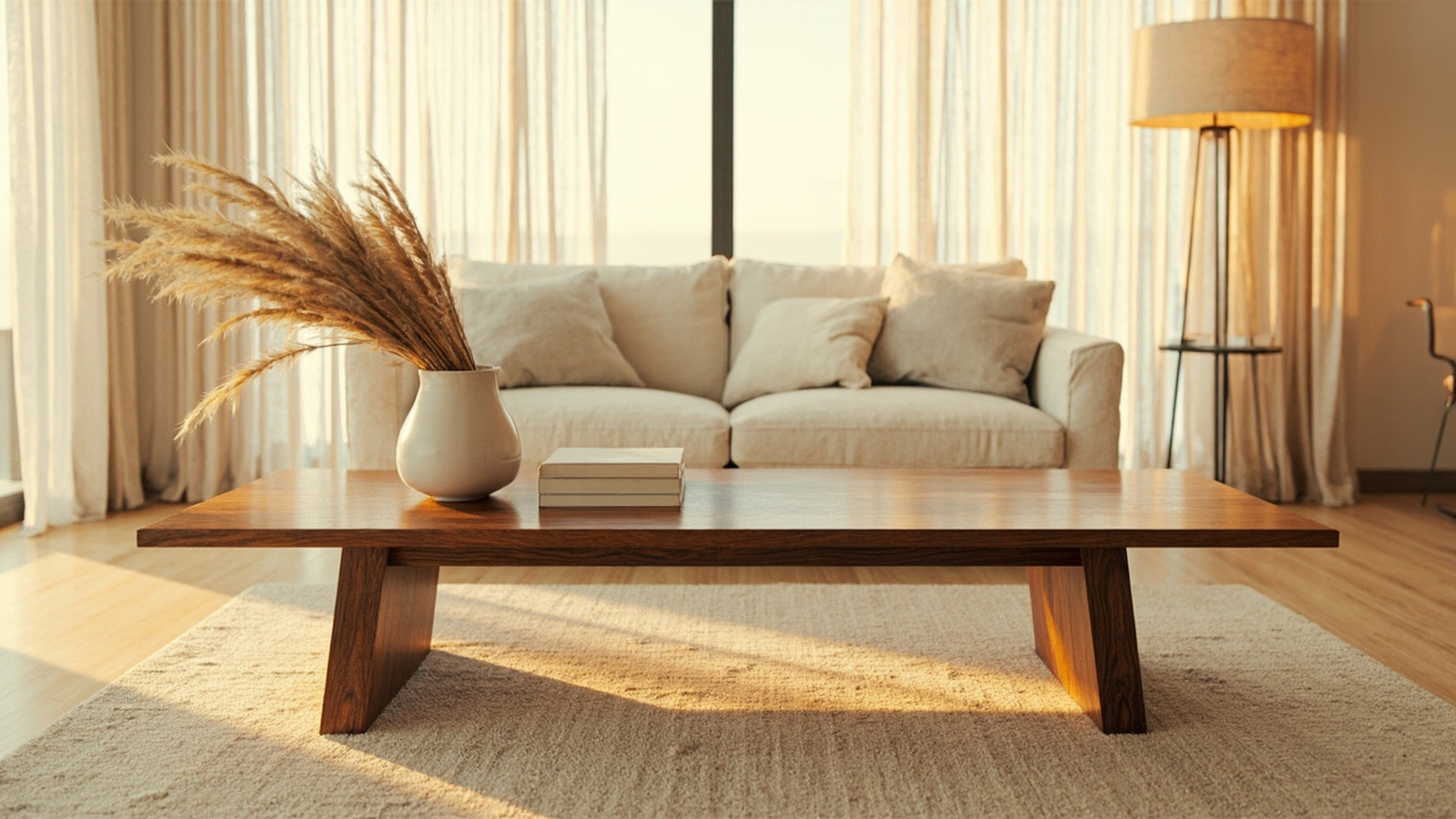
A coffee table is the workhorse of the living room — it anchors the seating area, holds everything from remotes to mugs, and quietly does more for your space than almost any other piece of furniture. Pair it with the right sofa selection guide for balanced visual proportions, or browse our best coffee tables roundup for current picks. Get the dimensions wrong, though, and you’ll either stretch awkwardly for your coffee or constantly bump your shins. This guide walks through every dimension that matters, from standard rectangular tables to round and oval shapes, plus the proportions your sofa expects.
Why Coffee Table Dimensions Matter
Coffee table dimensions affect three things in your living room: visual balance, usability, and traffic flow. A table that is too high or too low throws off the visual rhythm of the seating area, makes it harder to reach for your coffee or laptop, and can either crowd the room or feel awkwardly small. The right dimensions turn the table into the natural focal point of the seating arrangement.
Visual balance with your sofa is the first test. The table should be roughly two-thirds the length of your sofa and sit at the same height as the sofa seat cushions. See our bookshelf selection guide and dresser dimensions guide for related proportional rules used across furniture. That’s a design principle most living rooms miss because the table was bought separately from the sofa.
Practical reach is the second test. The most-used surface should be within arm’s reach of every seat — typically 14 to 18 inches away. Anything more and you’ll stop using the table for drinks because reaching is uncomfortable.
Traffic flow is the third test. You need at least 30 inches of walking space behind the table if it’s between the sofa and a TV, or between the sofa and a wall. That minimum keeps people from turning sideways to navigate past the table.
What You Need
A coffee table that fits your space and serves how you use it. Before you buy, you’ll want:
- A tape measure for checking your sofa height, room depth, and walking path
- The dimensions of your sofa (length, seat height, seat depth)
- A clear idea of what you’ll put on the table (drinks only? laptop workspace? board games?)
- A budget that covers both the table and any styling you want to add
Standard Coffee Table Dimensions
The most common rectangular coffee table is 48 inches long, 24 inches wide, and 18 inches tall. That’s the sweet spot for a standard 84-inch sofa in a mid-sized living room. But “standard” only matters if it fits your room and your sofa — which is why the next sections break down the variables.
Typical Rectangular Coffee Table
Rectangular tables dominate because they fit the long, linear layout of most sofas. Standard rectangular dimensions run from 36 to 54 inches long, 18 to 30 inches wide, and 16 to 20 inches tall. The most popular size in American living rooms is 48x24x18 — close enough to two-thirds of an 84-inch sofa length to look proportional without dominating the room.
For larger sectionals (110 to 130 inches long), consider stepping up to a 54 to 60 inch rectangular table or pairing two smaller tables. A single small table in front of a sectional looks unfinished.
Standard Round Coffee Table Sizes
Round coffee tables come in two main size buckets. The smaller “drink table” style runs 24 to 30 inches in diameter and 18 to 22 inches tall — perfect for small apartments or beside a single chair. The larger “centerpiece” style runs 36 to 48 inches in diameter, also at 18 to 22 inches tall.
Round tables shine in tight spaces because there are no corners to bump into. They also feel less visually heavy than rectangular tables, which helps small living rooms feel more open. The trade-off is that a 48-inch round table eats up more floor space than a 48-inch rectangular table does.
Standard Oval Coffee Table Sizes
Oval tables combine the linear layout of rectangles with the softness of rounds. Standard oval dimensions run from 50 to 70 inches long, 24 to 36 inches wide, and 16 to 20 inches tall. A 60x30 oval is the most common size, working well with 84 to 96 inch sofas.
Ovals are particularly good for families with young kids because there are no sharp corners to fall into. If you’re building a family-friendly living room from scratch, check our TV stand selection guide to ensure the media console pairs correctly with the table. They’re also the best shape if you want to walk around the table — the rounded ends create natural curves in your traffic path.
Standard Square Coffee Table Sizes
Square coffee tables are the least common because they force you to commit to either a square seating arrangement or pair awkwardly with a rectangular sofa. A 36x36 square table works in front of a small loveseat or as an end table next to a chair. 40x40 or 44x44 squares are reserved for sectionals with chaise lounges where the seat arrangement naturally forms an L.
Coffee Table Dimensions by Room Size
The room size determines the maximum table footprint you can fit without crowding the traffic paths. The rule is simple: measure the distance between your sofa and the TV or opposite wall, then subtract 36 inches for walking clearance and 16 inches for sofa-to-table gap. That gives you your maximum table length.
Small Living Room (Under 100 sq ft)
Small rooms (under 100 square feet) want tables in the 30 to 40 inch length range and 18 to 22 inch width. A 36 inch rectangular table or a 30 inch round table fits comfortably in front of a small loveseat without dominating the room. Lift-top mechanisms add about 3 inches to the height when raised, so factor that in if you’re buying for a narrow doorway.
If your small room has an open floor plan and the table is visible from the kitchen or entryway, consider a glass top. Glass top tables visually disappear more than wood or metal, which makes small rooms feel less cramped. The Honyee Modern Coffee Table at $139.99 has a tempered glass top over a 42.5x28.5 wooden base — a good example of this visual-lightness trick.
Medium Living Room (100 to 200 sq ft)
Medium rooms can handle tables 40 to 50 inches long and 22 to 28 inches wide — the sweet spot where lift-top functionality pays off. With a 36 inch walking path behind and a 16 inch sofa-to-table gap, you have room to get up from the sofa without bumping into the table. The 48 inch rectangular is the workhorse of this room size.
Storage starts to matter in medium rooms because the table becomes a real surface for TV remotes, magazines, and the occasional laptop. Lift-top tables like the OLIXIS Wood Lift Top ($106.63) and the HAPPYMONT Lift Top ($57.99) at this size give you hidden storage without sacrificing floor footprint.
Large Living Room (200+ sq ft)
Large rooms want tables 50 to 60 inches long and 26 to 36 inches wide, often paired with full-size sectionals or two facing sofas. At this size, single tables can feel small, so consider two coffee tables or one large table plus side tables.
The Homeiju Coffee Table ($79.98) at 39 inches long works well in front of sectionals with a separate bench-style coffee table. Many designers in large rooms use what is essentially a coffee table + ottoman pairing to give the room a softer feel. Browse our reading chairs collection for additional seating that pairs with large-format tables.
Coffee Table Height and Proportions
Height is the most-overlooked dimension of coffee table sizing. The gold standard is to match sofa seat height — if your sofa cushions sit at 18 inches, your coffee table should also be at 18 inches. Within 1 inch up or down is acceptable. More than 2 inches off and you’ll feel like you’re reaching awkwardly up or down.
The Golden Rule: Table Height = Sofa Seat Height
Measure from the floor to the top of your sofa cushion. Use a soft measuring tape and press down lightly to simulate seated weight. That measurement is your target coffee table height.
Tall modern sofas (20 to 22 inch seat height) want tables at 19 to 22 inches. Traditional sofas (18 to 19 inches) want 17 to 19 inch tables. Low-profile sectional sofas (15 to 17 inches) want 14 to 17 inch tables for proportion.
Length and Spacing Rules
The two-thirds rule (table length should be roughly two-thirds of sofa length) is the easiest proportion to follow:
- 72 inch sofa → 48 inch table
- 84 inch sofa → 54 inch table
- 96 inch sofa → 60 inch table
- 110 inch sectional → 54 to 60 inch table (or two tables)
Spacing between sofa and table should be 14 to 18 inches — close enough to reach a drink, far enough to walk around. Spacing between table and the next barrier (TV, wall, second sofa) should be at least 30 inches for traffic flow, 36 inches if the path is a high-traffic route.
Thickness and Visual Weight
Tabletop thickness affects how substantial the table feels. Modern styles run 1 to 2 inch tops that look sleek. Our console tables guide covers narrow-table proportions for entryways if you need a complementary surface elsewhere. Traditional styles run 3 to 4 inch tops that look chunkier. Glass tops feel thinner than they are, which helps in small rooms. Solid wood tops feel heavier and last longer.
The VASAGLE 3-in-1 ($179.99) is a good example of a chunky traditional look — the lift-top has a real wood top with visible grain that makes the table feel substantial without being heavy to move.
Coffee Table Shape Comparison
Each shape has trade-offs in usability, look, and traffic flow.
Rectangular — Best for Most Rooms
Rectangular tables are the most common because they naturally fit between the sofa and TV or wall. Most rectangular tables run 48 to 54 inches long, which is the sweet spot for the typical 84 to 96 inch sofa.
Pros: maximizes surface area, fits naturally with linear seating, looks proportional with rectangular sofas. Cons: sharp corners can be a hazard in tight spaces, can feel stark.
Round — Best for Small Spaces and Safety
Round tables work in tight spaces and with families because no one can bump a sharp corner. Sizes run 30 to 48 inches in diameter.
Pros: no sharp corners, looks softer, encourages conversation (everyone equal distance from center). Cons: wastes perimeter space, hard to fit a laptop and a drink both comfortably.
Oval — Soft Look, Good for Active Families
Ovals are the most versatile shape because they combine the workhorse surface of rectangles with the soft profile of rounds. Sizes run 50 to 70 inches long.
Pros: no sharp corners, room for laptop + drink + magazine, looks proportional in most rooms. Cons: more expensive than equivalent rectangles, harder to find.
Square — Limited Use, Best for Sectionals
Squares only work with square seating arrangements or with sectionals that have a strong L-shape. They’re also the hardest to walk around because all sides feel like “front.”
Pros: equal distance from all seats, symmetrical look. Cons: hard to walk around, looks awkward with rectangular sofas, wastes space behind one edge.
Top Picks by Style and Budget
Here are six well-vetted picks across price tiers and styles.
Best Budget: Furinno Simple Design Coffee Table at $26.90
The Furinno Simple Design Coffee Table is a no-frills rectangular table in French Oak Grey or Black finish at $26.90. At 39 inches long x 19 inches wide x 18 inches tall, it’s narrower than typical (24 inches would be standard) but works well in tight rooms where every inch matters. Buyers confirm the assembly is straightforward — about 15 minutes with the included Allen wrench. The simple design blends with both modern and traditional decor.
Best Value Lift-Top: HAPPYMONT Wood Lift Top Coffee Table at $57.99
The HAPPYMONT Wood Lift Top Coffee Table is a standout at the $57.99 price point because it includes a working lift-top mechanism plus a hidden storage compartment. At 39 inches long x 19.7 inches wide x 18.5 inches tall, it’s a medium-fit for most rooms. Buyers specifically mention the lift mechanism is smooth and quiet, and the hidden compartment fits blankets, board games, or laptop accessories.
Best Mid-Range: Homeiju Coffee Table at $79.98
The Homeiju Coffee Table brings modern farmhouse styling to the mid-range. At 39 inches x 18 inches x 32 inches tall with a 2-tier storage shelf, the slatted sides reference farmhouse architecture while the wood-look top works in modern or transitional rooms. The 32 inch height is generous — verify it matches your sofa height before buying.
Best Glass Top: Honyee Modern Coffee Table at $139.99
The Honyee Modern Coffee Table is a 42.5x28.5 glass-top table with a triangle tempered glass surface over a wood-tone base. At $139.99, it’s the priciest table on this list excluding the VASAGLE premium, but the glass top creates the most visually lightweight option — perfect for small rooms. The triangle shape is unusual and gives the table a subtle geometric interest without loud design.
Best Premium: OLIXIS Wood Lift Top Coffee Table at $106.63
The OLIXIS Wood Lift Top Coffee Table at $106.63 sits in the premium lift-top space. At roughly 40 inches long x 19.7 inches wide x 18.5 inches tall, it has the same footprint as the budget lift-tops but with a sturdier build and a more polished finish. The hidden compartment is large enough to fit a laptop, blankets, or board games.
Best Storage: VASAGLE 3-in-1 Lift Top Coffee Table at $179.99
The VASAGLE 3-in-1 Coffee Table is the storage champion at $179.99. With 2 drawers, 3 hidden compartments, plus a lift-top mechanism, it functions almost as a console + coffee table in one. The lift-top function elevates the work surface to laptop height — useful if you work from the sofa.
Common Sizing Mistakes to Avoid
Three mistakes show up over and over in coffee table sizing decisions.
Table Too Tall or Too Short
The most common mistake is buying a coffee table without measuring your sofa’s seat height. A table that is 3 inches too tall or too short feels uncomfortable to use for a drink or laptop. The fix is simple — measure before buying.
Table Overcrowds the Room
The second most common mistake is underestimating how much walking space is needed behind the table. In a small room, a 54 inch table eats all the air. Buy for the room you have, not the room you wish you had.
Material Mismatch with Sofa Style
The third mistake is ignoring style. A modern glass table in a traditional room feels disconnected. A farmhouse wood table in a minimalist space feels heavy. Match the table material and finish to the dominant style in your living room.
Frequently Asked Questions
What is the standard size of a coffee table?
The most common coffee table size is 48 inches long, 24 inches wide, and 18 inches tall. That fits a standard 84 inch sofa in a mid-sized living room. But “standard” only works if the dimensions match your sofa height, sofa length, and room walking space.
How do I choose the right coffee table height?
Match the table height to your sofa’s seat height. Sofa cushions typically sit 17 to 19 inches tall — your table should be within 1 inch of that, ideally at the same height. Beyond 2 inches off and the table becomes awkward to reach for a drink or laptop.
Should coffee table be higher or lower than sofa?
Coffee tables should be at the same height as the sofa cushion, or within 1 inch up or down. Higher tables block the line of sight across the room. Lower tables force you to bend down to set a drink. The at-same-height rule keeps the visual layer consistent and the ergonomics correct.
What size coffee table for a sectional?
For a 110 to 130 inch sectional, choose a coffee table 54 to 60 inches long. Alternatively, use two smaller tables (each 30 to 36 inches long) which can be spread out for group seating or pushed together for a single surface.
Is a round or rectangular coffee table better?
Rectangular tables work best in most living rooms because they fit the linear layout of sofas and TV setups. Round tables work better in small spaces and family homes because they have no sharp corners. Choose based on your room shape and who uses the table.
What is the 2/3 rule for coffee tables?
The table length should be roughly two-thirds of your sofa’s length. A 72 inch sofa wants a 48 inch table. A 96 inch sofa wants a 60 inch table. This proportion looks visually balanced without making the table dominate or disappear.
How much space do I need between sofa and coffee table?
Leave 14 to 18 inches between the sofa front and the table edge. That’s close enough for casual drink access but far enough to walk around. Anything closer than 12 inches feels crowded; anything past 22 inches is too far to reach comfortably.
Should coffee table be lighter or darker than sofa?
Lighter than the sofa if you want the table to be a subtle accent. Darker if you want the table to be a focal point. The mid-tone option (similar wood grain) is usually the most timeless — your eye reads them as a pair without drama.